HomeThe 1906 Path of Mob Violence

Coalition to Remember the 1906 Atlanta Race Massacre

The 1906 Path of Mob Violence

Twelve places on the route the Coalition drives each September: where the mob gathered, where it killed, what the city built over the places it happened, and where some of the dead are buried.

Take the tour from here

Twelve places, about 6.6 miles by car from the church to the cemetery. On the route, the tour can use your location to follow you and speak each site as you reach it. Location is never read until you tap Start, and it stays on your phone. Sources and credits.

Scroll to begin, or use the arrows below

First Congregational Church

Where the procession begins

105 Courtland Street NE, at John Wesley Dobbs Avenue. In 1906 this was Houston Street.

The congregation that met here in September 1906 was led by Henry Hugh Proctor. The building you see went up two years later.

First Congregational Church was founded in 1867 by freedpeople and white missionaries of the American Missionary Association. They met in the chapel of the Storrs School on Houston Street until 1877, when the association gave them this lot. In 1894 Henry Hugh Proctor became the congregation’s first Black pastor. 1

The church that stood here in 1906 was an earlier brick building. A photograph made around 1899 by Thomas Askew shows its members posed outside it. W. E. B. Du Bois gathered that photograph for the American Negro exhibit at the 1900 Paris Exposition, to show the world what Black Atlanta had built. 2

Houston Street, now John Wesley Dobbs Avenue, was where thirteen-year-old Walter White stood at a window with his father on the night of September 22, holding a gun. His father told him not to shoot until the first man put a foot on the lawn. White went on to lead the NAACP for twenty-five years. 3

After the massacre Proctor and the white lawyer Charles T. Hopkins formed the Interracial Committee of Atlanta, twenty Black men and twenty white men. Proctor then raised the money for this building, finished in 1908, with a library, a gymnasium, a thousand-seat auditorium, a residence for working women and a water fountain open to anyone. 4 In September 2023 the Fulton County Remembrance Coalition and the Equal Justice Initiative held a candlelight memorial here for the victims. The Coalition’s procession starts from this door. 5

The 1899 photograph shows the earlier church on this lot. The building here today went up in 1908.

Photographs 7 to look through. Select one to see it full size.

Sources for this site
  1. Georgia Historical Society marker, First Congregational Church (2002)
  2. Library of Congress, Members of the First Congregational Church, Atlanta, about 1899
  3. National Center for Civil and Human Rights, The Atlanta Race Massacre of 1906: A brief history, citing Walter White, A Man Called White (1948)
  4. Paula Lawton Bevington, Henry Hugh Proctor, New Georgia Encyclopedia
  5. Fulton County Remembrance Coalition, Atlanta Massacre of 1906 project
  6. Members of the congregation outside the church that stood on this lot before 1908. Photograph by Thomas E. Askew, around 1899, gathered by W. E. B. Du Bois for the American Negro exhibit at the 1900 Paris Exposition. Library of Congress, Prints and Photographs Division. No known restrictions. Record
about 1899 and nowMembers of the congregation outside the church that stood on this lot before 1908. Photograph by Thomas E. Askew, around 1899, gathered by W. E. B. Du Bois for the American Negro exhibit at the 1900 Paris Exposition. Drag the handle, or select a year.
Look aroundCourtland Street at John Wesley Dobbs Avenue, September 2026. Drag the picture to turn.
East on John Wesley Dobbs to Piedmont. Right on Piedmont, south to Decatur Street.

The old police headquarters

Decatur Street at Piedmont Avenue

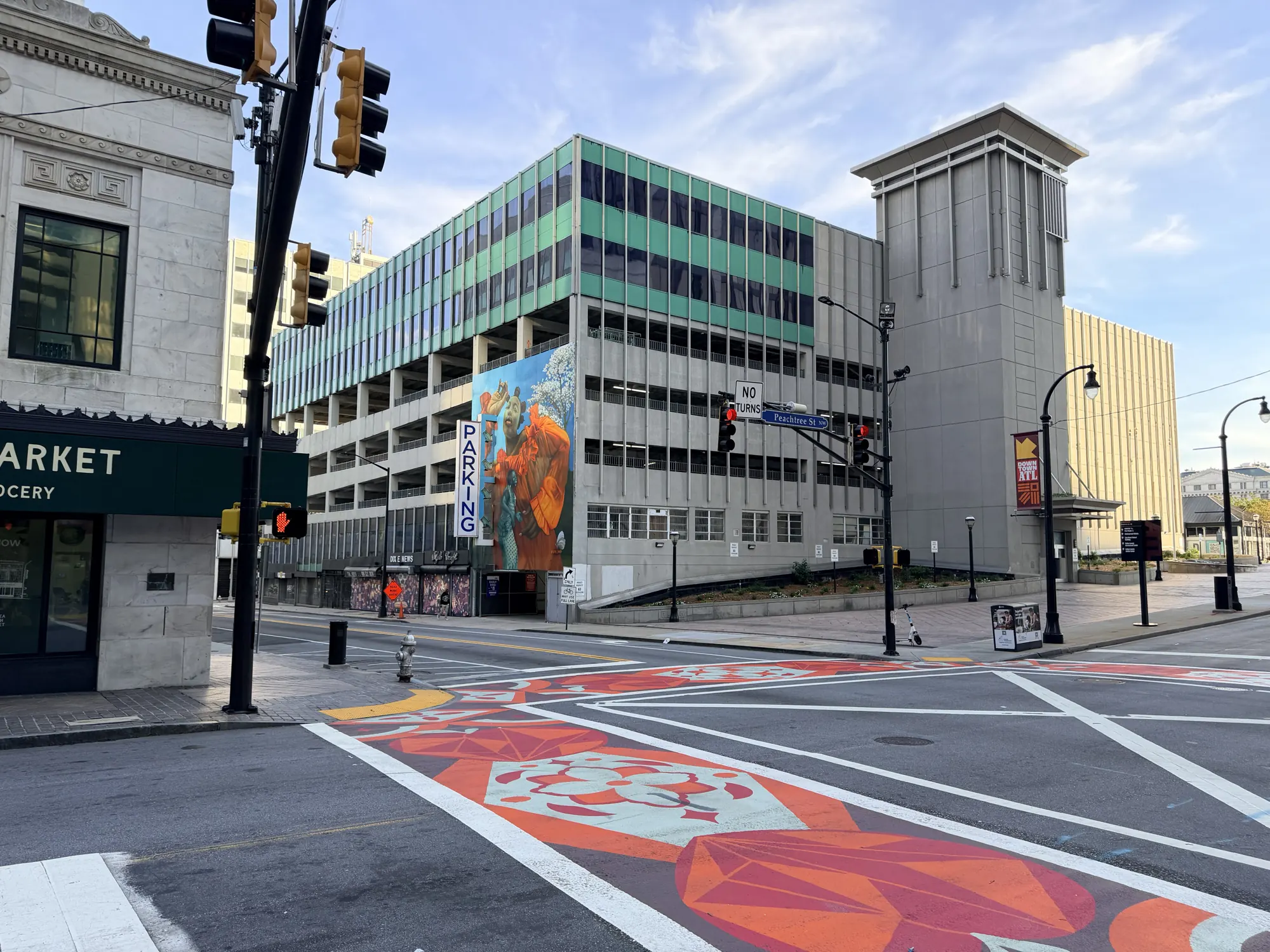
Decatur Street between Piedmont Avenue and Jesse Hill Jr. Drive, which was Butler Street. Georgia State University parking decks and a science building cover the block now.

Atlanta’s police headquarters stood on this block from 1893. On the night of the massacre the force was 233 men, and the Constitution reported them powerless.

The headquarters was built on Decatur Street in 1893, with the jail and the stables behind it. A photograph from 1895 shows its tower. Another, from 1899, shows the bicycle squad lined up in front. The building is gone. Georgia State University’s parking decks and its science building cover the block. 12

In 1906 the Atlanta police force was 233 men: a chief, three captains, a handful of sergeants and about 180 patrolmen, ten of them on bicycles. Every one of them was white. The city did not hire a Black officer until 1948. 34 On the morning after the first night the Constitution’s front page said: “Mob of 10,000 ruled city for five hours, police powerless, and troops not on scene until worst was over.” 5

Black residents ran here for protection while the mob held the streets, and the telephone wires the police depended on were cut. 6 The chief’s own annual report, written that January, calls the massacre “the unfortunate disturbance, or race riot, which was precipitated Saturday night, September 22nd, 1906,” and records no officer of the city force killed. 3

The Board of Police Commissioners that ran this building included James W. English, a bank president who also headed the Chattahoochee Brick Company and worked it with leased convicts. Weeks after the massacre, English summoned J. Max Barber, editor of The Voice of the Negro, who had written the truth about the mob to a New York paper, and gave him a choice: the chain gang or leave town. Barber moved his magazine to Chicago. 378

The headquarters stood on this block. Its exact frontage on the modern street has not been established.

Photographs 6 to look through. Select one to see it full size.

Sources for this site
  1. Georgia State University, History of Our Streets: Decatur Street, Piedmont to Butler
  2. Atlanta History Center, athpc/1205 (1895) and athpc/559 (1899)
  3. Twenty-Sixth Annual Report of the Chief of Police of the City of Atlanta for the Year 1906 (Kenan Research Center; photographed and transcribed for this project, 2026)
  4. Atlanta Police Department, APD History
  5. The Atlanta Constitution, September 23, 1906, page 1 (Kenan Research Center copy)
  6. David Fort Godshalk, Veiled Visions (2005), p. 96, as quoted in the Georgia State University walking tour
  7. National Center for Civil and Human Rights, The Atlanta Race Massacre of 1906: A brief history
  8. Douglas A. Blackmon, Slavery by Another Name (2008), on James W. English and the Chattahoochee Brick Company
  9. Atlanta Police Headquarters on Decatur Street, 1895. Photographer unknown. Atlanta History Center, Kenan Research Center, Atlanta History Photograph Collection, athpc/1205. Record
  10. The bicycle squad in front of headquarters on Decatur Street, between Butler Street and Piedmont Avenue, 1899. Atlanta History Center, Kenan Research Center, athpc/559. Record
1895 and nowAtlanta Police Headquarters on Decatur Street, 1895. Photographer unknown. Drag the handle, or select a year.
Look aroundDecatur Street at Piedmont Avenue, September 2026. Drag the picture to turn.
West on Decatur Street toward Five Points.

The Kimball House

Decatur Street at Pryor Street

Decatur Street at Pryor Street. The second Kimball House opened here in 1885 and was torn down in 1959. The block is a parking deck.

The Constitution said the trouble started at this corner. The mob went into the city’s grandest hotel and dragged its Black employees into the street.

The Kimball House was the grandest hotel in Atlanta, six stories of brick and iron filling the block between Decatur, Pryor and Wall streets, across from the railroad depot. This second building opened in 1885 after the first burned. A photograph from 1895 looks west along Decatur Street from just east of Pryor, with the hotel on the left, the same direction as the present frame. 12

On the morning after the first night, the Constitution’s front page summarized: “Trouble started at corner of Decatur and Pryor Streets.” 3 Around nine that evening a group of young white men attacked a Black bicycle messenger on Decatur Street. The violence spread from there. 4

Mobs invaded the Kimball House and the other fine hotels and dragged Black employees, the waiters, porters and bellmen, out into the street. 4 Decatur Street’s Black-owned restaurants and saloons, which the newspapers had spent the summer calling dens of vice, were wrecked the same night. 5

The hotel was demolished in 1959. A parking deck stands on the block. The Austell Building beside the Forsyth Street bridge, where the downtown route ends, is a parking lot too. Nothing on either block marks what happened there. 1

Photographs 7 to look through. Select one to see it full size.

Sources for this site
  1. Kimball House (Atlanta), Wikipedia
  2. Atlanta History Center, athpc/1164
  3. The Atlanta Constitution, September 23, 1906, page 1
  4. National Center for Civil and Human Rights, A brief history, p. 3
  5. Clifford Kuhn and Gregory Mixon, Atlanta Race Massacre of 1906, New Georgia Encyclopedia
  6. The Kimball House along Decatur Street, from east of Pryor Street looking west toward Five Points, 1895. The same direction as the present frame. Atlanta History Center, Kenan Research Center, athpc/1164. Record
  7. The Kimball House, looking west on Wall Street. Undated. Atlanta History Center, Kenan Research Center, athpc/201. Record
1895 and nowThe Kimball House along Decatur Street, from east of Pryor Street looking west toward Five Points, 1895. The same direction as the present frame. Drag the handle, or select a year.
Look aroundDecatur Street at Pryor Street, September 2026. Drag the picture to turn.
Continue west on Decatur Street into Five Points.

Five Points

Where the crowd gathered

Where Peachtree, Decatur, Marietta and Edgewood meet. The Flatiron Building, from 1897, was here in 1906.

Thousands gathered here on the afternoon of September 22, 1906, drawn by each new extra edition. By nine that night they were pulling Black passengers off the streetcars.

Five Points was the center of the city. The streetcar lines crossed here, and on a Saturday it was always crowded. On September 22, 1906 the crowd was different. The four white daily papers had spent the summer printing lurid and invented stories of Black men assaulting white women, and that afternoon they reported four new ones in extra edition after extra edition. Many of the men gathering here had brought weapons. 1

After the first attack on Decatur Street around nine, mobs pulled people off the streetcars that met here and beat and stabbed them. “Mob pulled negroes from cars and chased them on streets whenever one was seen,” the Constitution reported the next morning. “Trolley cars smashed and many show windows broken.” 12 The mob attacked every Black man, woman or boy it saw, the journalist Ray Stannard Baker wrote after coming to Atlanta to find out what had happened. 3

The governor called out the state militia around midnight, and the streetcar service was stopped. Heavy rain around three in the morning ended the first night. 14 The two photographs the Atlanta History Center holds of the militia, one on Peachtree just south of here and one on Marietta Street, were taken in the days after. There is no photograph of the violence itself. 5

Two rooftop photographs from 1906 look down on this intersection, one from the Candler Building and one from the Century Building at Whitehall and Alabama. The Flatiron Building in them, finished in 1897, is still here. 5

The militia photograph was made on Peachtree just south of the intersection, looking north.

Photographs 11 to look through. Select one to see it full size.

Sources for this site
  1. National Center for Civil and Human Rights, A brief history, pp. 3-4
  2. The Atlanta Constitution, September 23, 1906, page 1
  3. Ray Stannard Baker, “Following the Color Line: A Race Riot, and After,” The American Magazine, April 1907 (Kenan Research Center copy)
  4. Kuhn and Mixon, New Georgia Encyclopedia
  5. Atlanta History Center, athpc/1121, 1044, 3140, 3145; Library of Congress, Whitehall and Marietta Streets, 1905
  6. Georgia State Militia on Peachtree Street just south of Five Points, in the days after the massacre, 1906. Atlanta History Center, Kenan Research Center, athpc/1121. Record
  7. Whitehall and Marietta streets at Five Points, one year before the massacre. Rotograph postcard, 1905. Library of Congress, Prints and Photographs Division. No known restrictions. Record
  8. Five Points looking south from the Candler Building, 1906. The Flatiron Building is still standing. Atlanta History Center, Kenan Research Center, athpc/3140. Record
  9. Five Points from the Century Building at Whitehall and Alabama streets, 1906. Atlanta History Center, Kenan Research Center, athpc/3145. Record
1906 and nowGeorgia State Militia on Peachtree Street just south of Five Points, in the days after the massacre, 1906. Drag the handle, or select a year.
Look aroundFive Points, September 2026. Drag the picture to turn.
Cross Peachtree. Decatur becomes Marietta Street. Herndon’s shop was a block up Peachtree to the right.

Herndon’s barbershop

66 Peachtree Street

66 Peachtree Street NW, across from Woodruff Park. A block north of Five Points.

Alonzo Herndon, born enslaved, ran the finest barbershop in the South here. The mob smashed its windows. Barbers on this street were killed.

Alonzo Herndon was born into slavery in Walton County in 1858. By 1906 he owned the most celebrated barbershop in the South, at 66 Peachtree Street: marble, mirrors, crystal chandeliers and twenty-five chairs, cutting the hair of the city’s white business establishment. The year before, he had founded the company that became Atlanta Life Insurance. 1

On the night of September 22 the mob came up Peachtree. Accounts differ on what it did here. The New Georgia Encyclopedia says the mob smashed the windows of Herndon’s shop, that Herndon had closed early and was at home, and that a barbershop across the street was raided and its barbers killed. 2 The National Center for Civil and Human Rights says the mob barged into Black-owned barbershops, Herndon’s among them, and assaulted the barbers and bootblacks. A lame bootblack was beaten to death. 3 A Georgia State University history of the street counts two smashed windows here and one murdered bootblack. 4

A Harper’s Weekly engraving from the days after shows the state militia and a streetcar at Walton Street and Peachtree, one block south of here. 5

Herndon remodeled the shop in 1913 and named it the Crystal Palace. The three-story building at 66 Peachtree still stands, its front little changed, its interior empty. Herndon died in 1927 the wealthiest Black man in Atlanta. 14

Photographs 7 to look through. Select one to see it full size.

Sources for this site
  1. Carole Merritt, The Herndons: An Atlanta Family (University of Georgia Press, 2002)
  2. Kuhn and Mixon, New Georgia Encyclopedia
  3. National Center for Civil and Human Rights, A brief history, p. 3
  4. Georgia State University, History of Our Streets: 66 Peachtree Street, Herndon’s Crystal Palace (2025)
  5. Atlanta History Center, athpc/1117
  6. Inside Alonzo Herndon’s barbershop on Peachtree Street, 1903. Marble, mirrors and twenty-five chairs. Atlanta History Center, Kenan Research Center.
  7. State troops and a streetcar at Walton Street and Peachtree, one block south of the shop, in the days after. Reproduced in Harper’s Weekly, 1906. Atlanta History Center, Kenan Research Center, athpc/1117. Record
1903 and nowInside Alonzo Herndon’s barbershop on Peachtree Street, 1903. Marble, mirrors and twenty-five chairs. Drag the handle, or select a year.
Look aroundPeachtree Street at Woodruff Park, September 2026. Drag the picture to turn.
West on Marietta Street to Forsyth Street.

The Bijou Theater

Marietta at Forsyth

Northeast corner of Marietta and Forsyth streets. DeGive’s Opera House stood here from 1870; the office building at 41 Marietta replaced it.

The Bijou’s manager pulled three Black draymen into the theater and held the mob off at pistol-point.

Laurent DeGive opened his opera house on this corner on January 24, 1870. By 1906 the old building was the Bijou Theater, a popular-priced house across from the Grady monument. 1 A photograph from October 1891 shows it packed with people on the day the monument was unveiled. 2

As the mob moved along Marietta Street on the night of September 22, three Black draymen, wagon drivers, were caught outside the theater. The manager, J. B. Belser, pulled them inside and stood in the doorway with a pistol until the crowd moved on. 3

It is one of the few moments the record holds of a white Atlantan standing between the mob and the people it was hunting. Across the street, at the base of the monument, the mob left three bodies. 4

The opera house was demolished in 1921 for the Palmer Building, which was replaced in 1976 by the office tower at 41 Marietta Street. 1

The 1891 photograph was taken from above the street. The corner and the converging streets are the match, not the building.

Photographs 6 to look through. Select one to see it full size.

Sources for this site
  1. DeGive’s Opera House, Wikipedia, citing Steve Goodson (2007)
  2. Atlanta History Center, athpc/2288
  3. Godshalk, Veiled Visions, p. 93, as quoted in the Georgia State University walking tour
  4. National Center for Civil and Human Rights, A brief history, p. 3
  5. DeGive’s Opera House, later the Bijou, with the crowd at the unveiling of the Grady monument across the street. October 21, 1891. Atlanta History Center, Kenan Research Center, athpc/2288. Record
1891 and nowDeGive’s Opera House, later the Bijou, with the crowd at the unveiling of the Grady monument across the street. October 21, 1891. Drag the handle, or select a year.
Look aroundMarietta Street at Forsyth Street, September 2026. Drag the picture to turn.
The Grady monument is in the middle of Marietta Street at this corner.

The Henry Grady statue

Marietta Street at Forsyth

Marietta Street at Forsyth Street. The monument was unveiled on October 21, 1891.

The mob laid the bodies of three of its victims at the base of this statue. It is one of the few things on this route that stood here in 1906.

Henry W. Grady was the editor of the Atlanta Constitution who sold the country the idea of a “New South,” modern, industrial and reconciled. He died in 1889. This monument to him was unveiled on Marietta Street on October 21, 1891 before a crowd that filled the street. 12

On the night of September 22, 1906, members of the mob laid the bodies of three of the people they had killed at the base of the statue. The historian David Fort Godshalk records it; the National Center for Civil and Human Rights calls it “a gruesomely symbolic gesture.” 3

A photograph in the Atlanta History Center shows the state militia halted on Marietta Street near Peachtree in the days after, a block from here. 4 The monument has not been moved since 1891. It and the Flatiron Building at Five Points are among the few structures on this route that stood in 1906 and still stand.

On September 18, 2023, the National Center for Civil and Human Rights held a vigil at this statue and read two names that had gone uncounted for 117 years: Marshall Carter, thirteen, and Stinson Ferguson, twenty-five. Their death certificates had been on file the whole time. 5

Photographs 9 to look through. Select one to see it full size.

Sources for this site
  1. Statue of Henry W. Grady, Wikipedia
  2. Atlanta History Center, athpc/222 and athpc/218
  3. National Center for Civil and Human Rights, A brief history, p. 3, citing Godshalk, Veiled Visions
  4. Atlanta History Center, athpc/1044
  5. National Center for Civil and Human Rights, Unearthing the Past (2023); Atlanta News First, September 18, 2023
  6. The Henry W. Grady monument on Marietta Street, 1895. Atlanta History Center, Kenan Research Center, athpc/218. Record
  7. Georgia State Militia halted on Marietta Street near Peachtree in the days after the massacre, 1906. Atlanta History Center, Kenan Research Center, athpc/1044. Record
  8. The crowd at the unveiling of the Grady monument, looking west from Broad Street. October 21, 1891. Atlanta History Center, Kenan Research Center, athpc/222. Record
1895 and nowThe Henry W. Grady monument on Marietta Street, 1895. Drag the handle, or select a year.
Look aroundThe Grady monument on Marietta Street, September 2026. Drag the picture to turn.
Left onto Forsyth Street, south across the bridge.

The Forsyth Street bridge

Over the railroad gulch

Forsyth Street over the railroad gulch, between Marietta and Alabama streets. The 1906 bridge was torn down in 1930.

Frank Smith, a Western Union messenger still in his teens, was stabbed, stoned and thrown from the bridge that stood here.

In 1906 Forsyth Street crossed the railroad tracks on an iron truss bridge with a lattice railing and a stair down to the lower street. A photograph taken that year shows it beside the twelve-story Austell Building, home of the Atlanta Journal. 1

Frank Smith was a Western Union messenger. His headstone gives his birth as February 16, 1887, which makes him nineteen; Capital B Atlanta’s account says eighteen. On the first night of the massacre he was stabbed, stoned and thrown from this bridge. 23 The National Center for Civil and Human Rights records the mob mutilating corpses and “throwing one off the Forsyth Street bridge.” 4 Smith is buried at South-View Cemetery, the last stop on this route, where his headstone still stands. 6

The bridge was torn down in 1930 to make room for the viaduct that carries the street now. Atlanta raised its downtown streets over the tracks through the 1920s; the buried street level below is what reopened as Underground Atlanta. The Austell Building is gone too. Its site is the parking lot at 10 Forsyth Street, behind the fence and the mural. 15

This is the last downtown site. From here the procession turns south, toward Brownsville, where the killing continued on Monday and Tuesday, and to South-View Cemetery, where some of the dead are buried.

The bridge in the photographs is gone. The present frame looks along the crossing that replaced it.

Photographs 9 to look through. Select one to see it full size.

Sources for this site
  1. Atlanta History Center, athpc/1242 (1906) and athpc/2006 (1897); Georgia State University, AJC Photographic Archive, ajc/2478, April 14, 1930
  2. Fulton County Remembrance Coalition, Atlanta Race Massacre of 1906 Narrative
  3. Ann Hill Bond, Capital B Atlanta, September 26, 2025
  4. National Center for Civil and Human Rights, A brief history, p. 3
  5. Georgia State University Library, The Elevated City: Origins of Underground Atlanta
  6. WABE and the National Center for Civil and Human Rights, (re)Defining History: Uncovering the 1906 Atlanta Race Massacre (2023), in which Ann Hill Bond visits Frank Smith’s grave; headstone photographs, Find a Grave memorial 198476290
  7. The south side of the Austell Building with the Forsyth Street bridge and its stair on the right, 1906. This is the bridge, in the year it happened. Atlanta History Center, Kenan Research Center, athpc/1242. Record
  8. The Austell Building with the Forsyth Street bridge in the foreground, August 29, 1897. Atlanta History Center, Kenan Research Center, athpc/2006. Record
  9. Forsyth Street looking north from the old Constitution Building, with the Atlanta Journal Building on the right and the Austell Building on the left, 1922. Atlanta History Center, Kenan Research Center, athpc/1185. Record
1906 and nowThe south side of the Austell Building with the Forsyth Street bridge and its stair on the right, 1906. This is the bridge, in the year it happened. Drag the handle, or select a year.
Look aroundForsyth Street at the railroad gulch, September 2026. Drag the picture to turn.
South on Forsyth to Memorial Drive. Left on Memorial, right on Hank Aaron Drive, left on McDonough Boulevard, right onto Jonesboro Road.

Brownsville

South Atlanta

Where McDonough Boulevard meets Jonesboro Road and Gammon Street. The neighborhood is called South Atlanta today. The historical marker stands at the west end of Gammon Street.

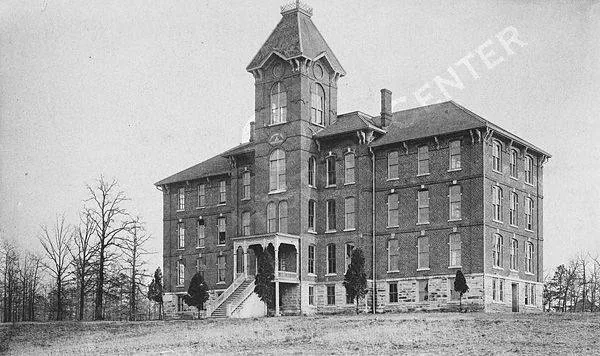
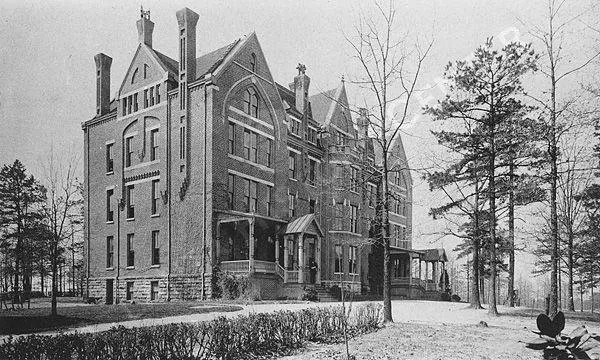
Chrisman Hall at Clark University in 1895: a large brick building with a central tower on open ground.
Chrisman Hall on the campus of Clark University in south Atlanta, 1895. Atlanta History Center, Kenan Research Center, athpc/135.
A residence hall at Gammon Theological Seminary in 1895, a long brick building with a mansard roof.
A residence hall at Gammon Theological Seminary, at the end of Capitol Avenue, 1895. Atlanta History Center, Kenan Research Center, athpc/206.

A Black suburb of two thousand people, anchored by Clark University and Gammon Theological Seminary. On Monday night a posse marched in. The residents fought back.

A Black suburb of two thousand people, anchored by Clark University and Gammon Theological Seminary. On Monday night a posse marched in. The residents fought back.

Brownsville began when Bishop Gilbert Haven bought 450 acres south of Summerhill in 1877. The land became the campuses of Gammon Theological Seminary and Clark University, and in 1887 Clark’s South Atlanta Land Improvement Company laid out fifty acres beside the college as a Black suburb. By 1904 about two thousand people lived here: professors, a postmaster, ministers, shopkeepers. 1 Photographs from 1895 show Chrisman Hall at Clark and a residence hall at Gammon. 2

After the first night downtown, Brownsville’s residents armed themselves. As it got dark on Monday, September 24, a posse of ten police officers and armed white civilians marched in, believing the neighborhood was stockpiling weapons. A gun battle followed. James Heard, a thirty-year-old Fulton County officer, was killed. So was George Wilder, seventy, a disabled veteran of the Union army. 3

Three companies of militia then occupied Brownsville, seized weapons and arrested more than 250 Black men, including professors from the two colleges. 4 The marker the Equal Justice Initiative and the Fulton County Remembrance Coalition placed here in 2022 records that nearly sixty residents were arrested and sentenced for the officer’s death. 1 On Tuesday, September 25, Will Moreland and James Fletcher were killed by Atlanta police on Randolph Street, Frank Fambro was shot at his grocery, and George Wilder’s body was found in a shed behind Fambro’s store. 5

The journalist Ray Stannard Baker, who came to Atlanta afterward, wrote that practically every resident of Brownsville had kept their home. 1 Luther Judson Price’s post office and house are the next two stops.

Photographs 2 to look through. Select one to see it full size.

Sources for this site
  1. The History of Brownsville / Brownsville and the 1906 Atlanta Race Massacre, historical marker, Equal Justice Initiative and Fulton County Remembrance Coalition, 2022
  2. Atlanta History Center, athpc/135 and athpc/206
  3. National Center for Civil and Human Rights, A brief history, p. 4
  4. Kuhn and Mixon, New Georgia Encyclopedia
  5. Fulton County Remembrance Coalition, Atlanta Race Massacre of 1906 Narrative
  6. Chrisman Hall on the campus of Clark University in south Atlanta, 1895. Atlanta History Center, Kenan Research Center, athpc/135. Record
  7. A residence hall at Gammon Theological Seminary, at the end of Capitol Avenue, 1895. Atlanta History Center, Kenan Research Center, athpc/206. Record
Right onto Gammon Street. The store stood at this corner.

The old post office

Luther Judson Price’s store

The corner of Gammon Street and Jonesboro Road. Luther Judson Price’s general store, with the post office inside it.

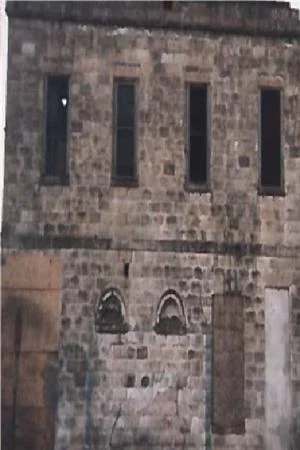
A two-story stone building with four tall, narrow upper windows and boarded openings at street level.
The Price store building at Gammon Street and Jonesboro Road, in an undated photograph from Atlanta Public Schools’ account of Price. Atlanta Public Schools, Luther Judson Price page (archived 2022).

Luther Judson Price was appointed postmaster of South Atlanta in 1889, the first post office in the community. The mob came looking for him.

Luther Judson Price was appointed postmaster of South Atlanta in 1889, the first post office in the community. The mob came looking for him.

Luther Judson Price was born enslaved in Sunnyside, Georgia, in 1856. He was among the first graduates of Clark College and bought a general store at the corner of Gammon Street and Jonesboro Road. On June 18, 1889, Postmaster General John Wanamaker appointed him postmaster of South Atlanta, the community’s first, a federal post he held for twenty-five years. The post office was inside his store. He and his wife Minnie lived above it with their children before they built the house down the street. 123

In September 1906 white mob leaders accused Price of selling ammunition to his Black neighbors, and the mob ransacked Brownsville looking for him. The police reached him first. The school system’s account says the car carrying Price pulled away as the mob came around the corner, and took him to the Fulton County jail. He was charged with furnishing guns and ammunition. The charge was dropped. 23

Price and Minnie Price led voter registration drives for Black citizens and organized for the Republican Party of their day. The Georgia legislature answered the massacre by passing a literacy test with grandfather clauses in 1907, made law by constitutional amendment in 1908, which took the vote from most Black Georgians for the next half century. 24

Price kept the store for more than fifty years. Atlanta Public Schools’ account of him says the building can still be seen, in need of repair. 3

Photographs 1 to look through. Select one to see it full size.

Sources for this site
  1. The History of Brownsville historical marker, 2022
  2. Associated Press, “This Old House: Restoration honors Black Atlanta postmaster,” September 7, 2022
  3. Atlanta Public Schools, Luther Judson Price
  4. Kuhn and Mixon, New Georgia Encyclopedia
  5. The Price store building at Gammon Street and Jonesboro Road, in an undated photograph from Atlanta Public Schools’ account of Price. Atlanta Public Schools, Luther Judson Price page (archived 2022). Record
West along Gammon Street.

The Luther Judson Price home

Gammon Street SE

Gammon Street SE, between the old seminary grounds and the store. Built around 1900. A private home today. Please view it from the street.

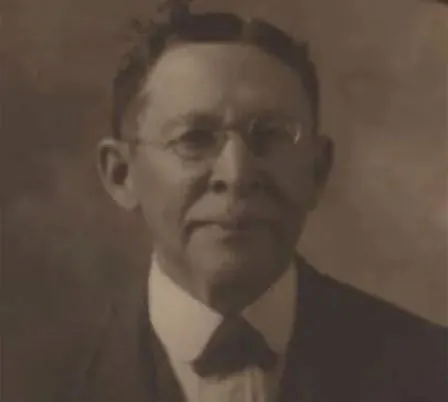
A portrait photograph of Luther Judson Price, a Black man with a white beard in a dark suit.
Luther Judson Price. He lived in this house until his death in 1936. Atlanta Public Schools, Luther Judson Price page.

The house Luther and Minnie Price built about 1900, between the seminary and their store. Restored in 2022, and a family home again.

The house Luther and Minnie Price built about 1900, between the seminary and their store. Restored in 2022, and a family home again.

Luther and Minnie Wright Price married in 1889 and built this two-story, five-bedroom Victorian a few years later, on a two-block stretch of Gammon Avenue between Gammon Theological Seminary and their store and post office. Clark’s professors lived along this street. 12

Minnie Price, an Atlanta University graduate, shared her husband’s work as postmaster, church superintendent and Masonic officer. Together they encouraged their neighbors to register and vote. 1

Price lived here until his death in 1936. He is buried at South-View Cemetery. The city named a high school for him in the 1950s, later Price Middle School, a few blocks south. 34 His descendant Farrow Allen works at the National Center for Civil and Human Rights, which identified two more of the massacre’s victims in 2023. 5

The house stood in severe disrepair until a family bought it and restored it. This Old House filmed the work in eight episodes in 2022. It is a private home today. Please view it from the street. 12

Photographs 1 to look through. Select one to see it full size.

Sources for this site
  1. Associated Press via Georgia Public Broadcasting, September 7, 2022
  2. FOX 5 Atlanta, “Atlanta family’s restoration of historic home featured on This Old House”
  3. To Die For Images, Luther Judson Price, July 11, 2022
  4. Luther Judson Price, Wikipedia
  5. The Atlanta Voice, “Setting the record straight on 1906”; NCCHR staff page for Farrow Allen
  6. Luther Judson Price. He lived in this house until his death in 1936. Atlanta Public Schools, Luther Judson Price page.
On to the historical marker at the end of Gammon Street, then back to Jonesboro Road and south to South-View Cemetery.

South-View Cemetery

Where the procession ends

1990 Jonesboro Road SE. Founded in 1886.

Founded in 1886 so that Black Atlantans could bury their dead with dignity. Two people killed in the massacre have headstones that still stand here: George Union Wilder and Frank Smith.

Founded in 1886 so that Black Atlantans could bury their dead with dignity. Two people killed in the massacre have headstones that still stand here: George Union Wilder and Frank Smith.

South-View was founded in 1886 by Black Atlantans on the principle that a dignified burial place should be open to everyone, at a time when the city’s cemeteries were segregated. It covers more than a hundred acres and is still run by descendants of its founders. 1

George Union Wilder is buried here. He was seventy, had escaped slavery during the Civil War and enlisted in the United States Army, and took the middle name Union for his service. He was killed in Brownsville. His stone carries a hand-cut epitaph: “A soldier of the Civil War, was killed in the riot.” For years it was described as the only marked grave of a person killed in the massacre. 2

Frank Smith, the Western Union messenger thrown from the Forsyth Street bridge, is buried here too, and his headstone stands: born February 16, 1887, died September 22, 1906. 4

Marshall Carter, thirteen, and Stinson Ferguson, twenty-five, are buried here too. Their names were recovered in 2023 by researchers who found their Fulton County death certificates, each carrying the word “riot.” 3

The 2006 centennial began with a funeral motorcade and a memorial service at Wilder’s grave. 2 The Coalition’s procession ends here. Sixteen of the twenty-five people known to have been killed have been named. Every one of them had a name.

Photographs 0 to look through. Select one to see it full size.

Sources for this site
  1. South-View Cemetery Association
  2. National Center for Civil and Human Rights, A brief history, pp. 4-5, citing the U.S. Army pension file of George Union Wilder (National Archives)
  3. National Center for Civil and Human Rights, Unearthing the Past: Identifying Victims of the 1906 Atlanta Race Massacre (2023)
  4. WABE and the National Center for Civil and Human Rights, (re)Defining History: Uncovering the 1906 Atlanta Race Massacre (2023); headstone photographs, Find a Grave memorial 198476290

End of the tour

Every one of them had a name.

At least twenty-five people were killed in Atlanta in September 1906. Sixteen have been named. The Coalition keeps looking for the rest.

Back to the 1906 home pageRead the twenty-five names

Drag to look around

Let the tour follow you

The tour reads your location to know which site you are near, shows you on the map, and speaks each site as you reach it. Your location stays on your phone.

Keep the screen on and the sound up. The speaker button turns the narration off. If location is off or blocked, the Back and Next buttons still work. Passengers only, please: the driver drives.

Sources and credits

Route as published by the Coalition to Remember the 1906 Atlanta Race Massacre, “The 1906 Path of Mob Violence,” for the procession of September 20, 2026.

Present-day photographs, panoramas and the drive through downtown: Erik Wilder for the Coalition, September 12, 2026. Nothing on this page is generated: every photograph of 1906 is a record held by an archive, and every present-day image was made on the street.

Historical photographs from the Atlanta History Photograph Collection are reproduced by courtesy of the Kenan Research Center at the Atlanta History Center, with each record linked below. Library of Congress items carry no known restrictions on publication. Map data © OpenStreetMap contributors. Tiles by CARTO.

01 · First Congregational Church

  1. Georgia Historical Society marker, First Congregational Church (2002)
  2. Library of Congress, Members of the First Congregational Church, Atlanta, about 1899
  3. National Center for Civil and Human Rights, The Atlanta Race Massacre of 1906: A brief history, citing Walter White, A Man Called White (1948)
  4. Paula Lawton Bevington, Henry Hugh Proctor, New Georgia Encyclopedia
  5. Fulton County Remembrance Coalition, Atlanta Massacre of 1906 project

02 · The old police headquarters

  1. Georgia State University, History of Our Streets: Decatur Street, Piedmont to Butler
  2. Atlanta History Center, athpc/1205 (1895) and athpc/559 (1899)
  3. Twenty-Sixth Annual Report of the Chief of Police of the City of Atlanta for the Year 1906 (Kenan Research Center; photographed and transcribed for this project, 2026)
  4. Atlanta Police Department, APD History
  5. The Atlanta Constitution, September 23, 1906, page 1 (Kenan Research Center copy)
  6. David Fort Godshalk, Veiled Visions (2005), p. 96, as quoted in the Georgia State University walking tour
  7. National Center for Civil and Human Rights, The Atlanta Race Massacre of 1906: A brief history
  8. Douglas A. Blackmon, Slavery by Another Name (2008), on James W. English and the Chattahoochee Brick Company

03 · The Kimball House

  1. Kimball House (Atlanta), Wikipedia
  2. Atlanta History Center, athpc/1164
  3. The Atlanta Constitution, September 23, 1906, page 1
  4. National Center for Civil and Human Rights, A brief history, p. 3
  5. Clifford Kuhn and Gregory Mixon, Atlanta Race Massacre of 1906, New Georgia Encyclopedia

04 · Five Points

  1. National Center for Civil and Human Rights, A brief history, pp. 3-4
  2. The Atlanta Constitution, September 23, 1906, page 1
  3. Ray Stannard Baker, “Following the Color Line: A Race Riot, and After,” The American Magazine, April 1907 (Kenan Research Center copy)
  4. Kuhn and Mixon, New Georgia Encyclopedia
  5. Atlanta History Center, athpc/1121, 1044, 3140, 3145; Library of Congress, Whitehall and Marietta Streets, 1905

05 · Herndon’s barbershop

  1. Carole Merritt, The Herndons: An Atlanta Family (University of Georgia Press, 2002)
  2. Kuhn and Mixon, New Georgia Encyclopedia
  3. National Center for Civil and Human Rights, A brief history, p. 3
  4. Georgia State University, History of Our Streets: 66 Peachtree Street, Herndon’s Crystal Palace (2025)
  5. Atlanta History Center, athpc/1117

06 · The Bijou Theater

  1. DeGive’s Opera House, Wikipedia, citing Steve Goodson (2007)
  2. Atlanta History Center, athpc/2288
  3. Godshalk, Veiled Visions, p. 93, as quoted in the Georgia State University walking tour
  4. National Center for Civil and Human Rights, A brief history, p. 3

07 · The Henry Grady statue

  1. Statue of Henry W. Grady, Wikipedia
  2. Atlanta History Center, athpc/222 and athpc/218
  3. National Center for Civil and Human Rights, A brief history, p. 3, citing Godshalk, Veiled Visions
  4. Atlanta History Center, athpc/1044
  5. National Center for Civil and Human Rights, Unearthing the Past (2023); Atlanta News First, September 18, 2023

08 · The Forsyth Street bridge

  1. Atlanta History Center, athpc/1242 (1906) and athpc/2006 (1897); Georgia State University, AJC Photographic Archive, ajc/2478, April 14, 1930
  2. Fulton County Remembrance Coalition, Atlanta Race Massacre of 1906 Narrative
  3. Ann Hill Bond, Capital B Atlanta, September 26, 2025
  4. National Center for Civil and Human Rights, A brief history, p. 3
  5. Georgia State University Library, The Elevated City: Origins of Underground Atlanta
  6. WABE and the National Center for Civil and Human Rights, (re)Defining History: Uncovering the 1906 Atlanta Race Massacre (2023), in which Ann Hill Bond visits Frank Smith’s grave; headstone photographs, Find a Grave memorial 198476290

09 · Brownsville

  1. The History of Brownsville / Brownsville and the 1906 Atlanta Race Massacre, historical marker, Equal Justice Initiative and Fulton County Remembrance Coalition, 2022
  2. Atlanta History Center, athpc/135 and athpc/206
  3. National Center for Civil and Human Rights, A brief history, p. 4
  4. Kuhn and Mixon, New Georgia Encyclopedia
  5. Fulton County Remembrance Coalition, Atlanta Race Massacre of 1906 Narrative

10 · The old post office

  1. The History of Brownsville historical marker, 2022
  2. Associated Press, “This Old House: Restoration honors Black Atlanta postmaster,” September 7, 2022
  3. Atlanta Public Schools, Luther Judson Price
  4. Kuhn and Mixon, New Georgia Encyclopedia

11 · The Luther Judson Price home

  1. Associated Press via Georgia Public Broadcasting, September 7, 2022
  2. FOX 5 Atlanta, “Atlanta family’s restoration of historic home featured on This Old House”
  3. To Die For Images, Luther Judson Price, July 11, 2022
  4. Luther Judson Price, Wikipedia
  5. The Atlanta Voice, “Setting the record straight on 1906”; NCCHR staff page for Farrow Allen

12 · South-View Cemetery

  1. South-View Cemetery Association
  2. National Center for Civil and Human Rights, A brief history, pp. 4-5, citing the U.S. Army pension file of George Union Wilder (National Archives)
  3. National Center for Civil and Human Rights, Unearthing the Past: Identifying Victims of the 1906 Atlanta Race Massacre (2023)
  4. WABE and the National Center for Civil and Human Rights, (re)Defining History: Uncovering the 1906 Atlanta Race Massacre (2023); headstone photographs, Find a Grave memorial 198476290

Read more

The history and the names of the twenty-five on the Coalition’s site. The National Center for Civil and Human Rights brief history is the best short account in print.